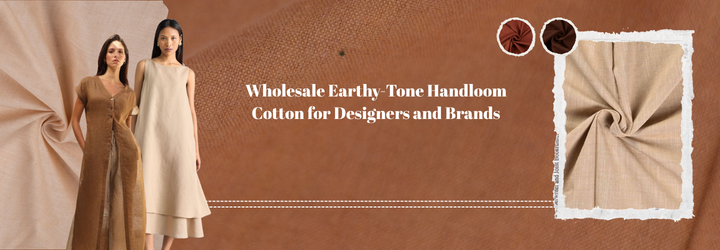
Wholesale Earthy-Tone Handloom Cotton for Designers

TL;DR
- Earthy tones — terracotta, ochre, rust, and warm brown — are among the most persistently demanded shades in sustainable fashion and home interiors, not just seasonal trends.
- Terracotta: the single most in-demand earthy shade for 2024–25, worn on runways at Valentino, Fendi, and Hermès; equally strong in home textiles
- Ochre & Amber: seasonally driven but with a long commercial tail—natural turmeric dye adds provenance; azo-free synthetic gives better consistency
- Rust & Burnt Orange: strongest in AW collections and interior upholstery; excellent colorfastness with azo-free dye
- Warm Beige & Sand: the versatile capsule base — shortest lead time, overdye-ready, lowest MOQ entry point
- Chocolate Brown: year-round commercial staple; functions as a neutral for brands building natural-palette collections
- Both sustainable fashion brands and interior designers are active buyers of earthy handloom cotton—this guide covers both use cases.
Earthy tones have been in fashion long enough to stop being called a trend. Terracotta, ochre, rust, warm brown, and sandy beige have become structural colors in sustainable fashion—shades that brands return to season after season because they align naturally with the 'made from the earth' narrative that ethical labels are built around.
For wholesale buyers, this means earthy-tone handloom cotton is a reliable stock story rather than a trend gamble. The question is not whether to source it, but which specific shades, which dye processes, and which weights suit your collection or interior application.
This guide is written for two audiences: sustainable fashion brands building natural-palette apparel collections and interior designers specifying handloom cotton for upholstery, cushion covers, curtains, and panel fabrics. Both are strong buyers of earthy handloom cotton, and both have specific requirements that are worth understanding before placing a wholesale order.
Market context: The global sustainable fashion market was valued at USD 8.1 billion in 2024 and is projected to reach USD 33.1 billion by 2033 at a CAGR of 22.9% (Custom Market Insights). Concurrently, the India home textile market reached USD 10.38 billion in 2025 and is projected to grow to USD 15.47 billion by 2030 at an 8.32% CAGR (Mordor Intelligence). Earthy tones are a leading color story in both categories—and handloom cotton sits at the intersection of both.
Why Earthy Tones Are a Structural Choice for Ethical Collections
Function-driven color strategy for consistent, ethical collections
Earthy tones earn their place in sustainable fashion collections for reasons that go beyond aesthetics. They have a functional alignment with the brand story that ethical labels are telling — and they perform commercially across seasons and markets.
- Narrative alignment: Terracotta, ochre, and rust are literally drawn from the earth—iron oxides, clay pigments, and plant-based dyes. For brands communicating a 'made from natural sources' story, these colours reinforce the message at a visual level before a word is read
- Season-spanning commercial life: unlike pastels or brights, earthy tones do not die between seasons. They are the core palette for AW collections but carry strongly through SS resort, transitional capsules, and year-round basics
- Cross-category strength: the same earthy cotton that works for a sustainable fashion label's jacket also works for an interior designer's cushion cover or panel curtain—this dual-channel demand makes earthy handloom cotton a reliable reorder story
- Runway validation continuing into 2025: Fendi and Burberry featured deep earth tones, including terracotta and olive in SS25; Valentino's AW25 collections continued to build on warm ochre and brick palettes—confirming that earthy tones have major-house momentum
The persistence of this palette is well documented: earthy tones including terracotta, sage, and warm beige are cited as 2025's defining color direction across fashion, interior design, and branding (Gelato Color Trends 2025)—a rare cross-industry convergence that makes wholesale procurement in these shades lower-risk than trend-dependent colors.
The Anuprerna Earthy Tone Palette
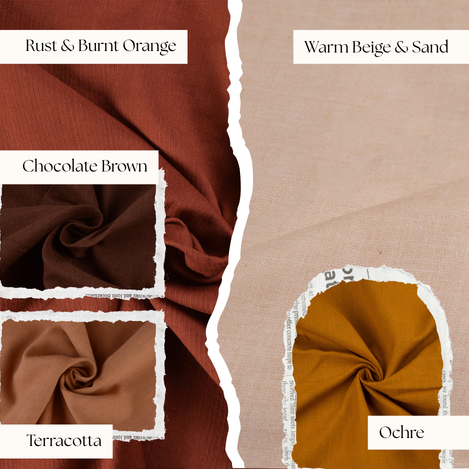
A Wholesale Shade Guide
Key shades, consistency standards, and bulk sourcing insights
Below is a buyer-oriented reference for Anuprerna's earthy-tone handloom cotton palette. Each section covers dye method, weight range, colorfastness, and recommended end uses across both fashion and interior applications.
1. Rust & Burnt Orange Handloom Cotton
Rust and burnt orange are the more saturated, darker members of the earthy palette—deeper than terracotta, with a stronger red undertone. On handloom cotton, rust achieves a depth and presence that makes it a standout choice for statement pieces in both apparel and interiors.
- Dye method: Azo-free synthetic dye — the most reliable route to a consistent, deep rust or burnt orange with commercial-grade colorfastness
- Typical GSM range: 140–220 GSM—the higher weight range is particularly popular for interior upholstery and structured outerwear
- Colorfastness: Grade 4–5 — rust shades are among the most colourfast in the earthy palette with azo-free synthetic dye
- Best for apparel: outerwear, structured jackets, winter-weight trousers, statement coats, workwear-inspired pieces
- Best for interiors: upholstery fabric for chairs and sofas, heavy curtain panel fabric, floor cushions
- Buyer tip: rust at 180–220 GSM is one of the most requested specifications from interior designer buyers—if your wholesale offer includes home décor, this weight and shade combination is worth stocking
2. Warm Beige & Sand Handloom Cotton
Warm beige and sand are the foundational shades of any earthy palette — neutral enough to anchor a collection but warm enough to feel intentional rather than default. On handloom cotton, undyed or lightly treated beige retains the natural tone of raw cotton with the characteristic slub texture that distinguishes handloom from industrial weaves.
- Dye method: Undyed or lightly treated — minimal processing, which also means the shortest lead time and widest availability
- Typical GSM range: 100–180 GSM — available across the full weight range
- Best for apparel: capsule collection base pieces, layering, gender-neutral basics, overdye-ready stock for in-house colour development
- Best for interiors: natural-palette interior schemes, linen-adjacent aesthetics, base fabric for block printing or surface embellishment
- MOQ: lowest entry point in the earthy palette—undyed fabric has the most flexible minimum order structure
Warm beige is the earthy palette's workhorse. Brands that begin with beige as a capsule base and layer deeper earthy tones over subsequent seasons build a cohesive natural-palette identity that is both commercially credible and creatively coherent.
3. Chocolate Brown Handloom Cotton
Chocolate brown is the year-round anchor of the earthy palette—a shade that reads as a neutral in sustainable fashion contexts and a warm, inviting base color in interior applications. Unlike trend-driven earthy shades, brown has consistent demand throughout the year and across markets.
- Dye method: Azo-free synthetic dye (for deep, consistent chocolate brown); natural walnut shell or myrobalan-based dye available for brands requiring natural provenance
- Typical GSM range: 120–200 GSM
- Colorfastness: Grade 4–5 with azo-free synthetic; Grade 3–4 with natural process
- Best for apparel: year-round wardrobe staples, trousers, outerwear, accessories—functions as a neutral tone for multi-colour collections
- Best for interiors: upholstery, window treatments, bedding components—pairs naturally with terracotta and ochre in coordinated interior schemes
4. Terracotta Handloom Cotton
Terracotta is the standout shade of the earthy palette—and the most in-demand single color in this range for both apparel and home. On handloom cotton, it achieves a warmth and depth that machine-woven cotton at the same weight cannot replicate. The slight surface irregularity of handloom weave interacts with terracotta pigment to produce a richness that reads beautifully in both natural and artificial light.
- Dye method: Azo-free synthetic dye (for consistent, reproducible terracotta across batch); natural iron-oxide-adjacent dye processes available for brands requiring documented natural provenance
- Typical GSM range: 120–200 GSM—lighter weights for apparel shirting and dresses; heavier for outerwear, upholstery, and curtain panel fabric
- Colorfastness: Grade 4–5 with azo-free synthetic; Grade 3–4 with natural process dyes
- Best for apparel: shirts, dresses, trousers, lightweight jackets, resort and holiday collections
- Best for interiors: cushion covers, panel curtains, upholstery fabric, table runners, decorative throws
- MOQ at Anuprerna: Low MOQ — contact team for current minimums by weight and width
Terracotta handloom cotton is consistently among the highest-reorder SKUs in the Anuprerna range. Buyers who begin with sample yardage typically proceed to bulk within one collection cycle.
5. Ochre & Amber Handloom Cotton
Ochre and amber occupy a warmer, more golden register than mustard—closer to sun-bleached earth than turmeric yellow. On handloom cotton, these shades carry a visual warmth that photographs exceptionally well and resonates strongly with the 'slow fashion, natural world' aesthetic.
- Dye method: Natural turmeric dye (for a softer, more muted golden ochre with living-dye character) or azo-free synthetic (for a richer, more saturated amber with better fastness)
- Natural dye note: turmeric-dyed fabric will soften and evolve with washing—a valued characteristic for slow fashion brands but worth communicating clearly to end consumers
- Typical GSM range: 100–180 GSM — most popular at 120–140 GSM for shirting and lightweight trousers
- Colorfastness: Natural dye Grade 3–4; azo-free synthetic Grade 4–5
- Best for apparel: AW capsule collections, summer-to-autumn transition pieces, festival and resort wear
- Best for interiors: warm-palette cushions, throws, and panel fabrics in Japandi or natural-material interior schemes
- Seasonal note: Peak wholesale demand for ochre typically arrives in Q2 as brands plan AW production—order sample yardage early in the cycle
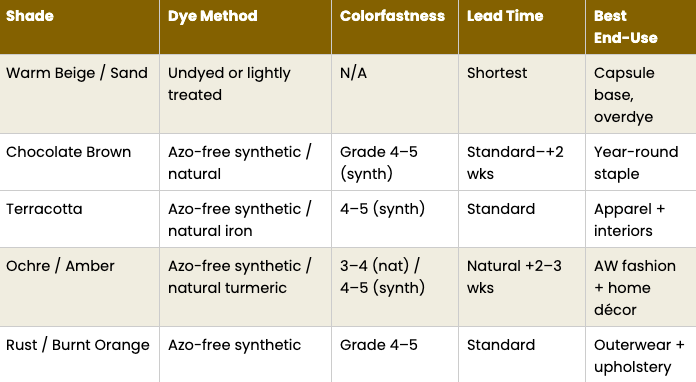
Earthy-Tone Quick Reference for Wholesale Buyers
Sourcing Earthy Handloom Cotton for Fashion vs. Interiors: Key Differences
Different buyer priorities across fashion and interior use
Anuprerna's earthy-tone handloom cotton serves two distinct wholesale buyer profiles—sustainable fashion brands and interior designers. While the fabric range overlaps, the buying considerations differ meaningfully.
For Sustainable Fashion Brands
- Weight priority: 100–160 GSM for most apparel; 160–200 GSM for structured outerwear
- Width: standard apparel fabric widths — confirm pattern-cutting requirements before ordering
- Dye consistency: azo-free synthetic recommended for any shade where batch consistency is required across a multi-style collection
- Certifications: GOTS-certified dye options available — important for EU and US market compliance and brand communication
- Seasonal planning: earthy tones are year-round, but ochre and rust peak in AW planning cycles—book sample yardage in Q1–Q2 for AW production
For Interior Designers
- Weight priority: 160–220 GSM for upholstery; 120–160 GSM for cushion covers and throws; 100–140 GSM for lightweight panel curtains
- Width: wider widths available for certain panel applications — confirm your specification with the team
- Durability: for upholstery applications, confirm rub fastness grade and abrasion performance—the team will advise on the best construction for your end-use
- Natural colour variation: handloom cotton's inherent batch variation is an asset in artisanal interior schemes—confirm this is compatible with your specification before ordering large runs
- Custom dyeing: Anuprerna offers custom colour development for interior designers specifying a particular earthy tone that is not in the standard range
Market context for interiors: the global textile home décor market was valued at USD 85 billion in 2023 and is projected to grow at a CAGR of 5.4% through 2032 (Global Market Insights). Artisan-made, natural-fiber fabrics in earthy tones are a premium segment within this market—driven by the 'sanctuary space' interior trend that prioritizes tactile, handmade, and natural-material pieces.
Ready to Source Your Next Best Selling Fabric?
The recommended sequence for new wholesale partners:
- Order a SwatchKit: Request physical swatches of your target earthy shades. Evaluate in your design studio under both daylight and artificial light—terracotta, ochre, and rust all shift significantly between lighting conditions.
- Specify GSM and width: Confirm your weight requirements for each end-use. Different earthy shades may be available in different weight ranges—the team will advise on current availability.
- Specify dye preference: Decide between azo-free synthetic (better consistency and colorfastness) or natural dye (stronger provenance story, living-dye character). This affects pricing, lead time, and certifications available.
- Request sample yardage: Cut and sew a test garment or produce a sample interior piece. Wash test under your own production or client conditions—particularly important for ochre and rust shades.
- Place wholesale order: Once the sample is approved, confirm shade, GSM, width, dye process, quantity, and delivery schedule with the Anuprerna wholesale team.
Ready to Build Your Natural Earthy Palette?
Test earthy tones and fabric weights before bulk commitment
Whether you are planning a sustainable fashion collection around a terracotta and ochre palette or specifying handloom cotton for an artisan-inspired interior scheme, Anuprerna's SwatchKit is the right starting point. Evaluate earthy tones in every shade and weight before committing to bulk—because in this palette, physical evaluation is everything.
frequently asked questions
Can I order terracotta, ochre, rust, and beige in a single wholesale shipment?
Yes. Anuprerna's low MOQ structure allows you to consolidate multiple earthy shades into a single order, provided each shade meets the minimum per-shade threshold. This is a popular approach for brands building a complete earthy, natural palette across a collection. Contact the team for current minimums by shade and weight.
How consistent is terracotta shade across different weave weights and batch sizes?
With azo-free synthetic dye, terracotta is highly consistent within a single batch and reproducible across repeat orders.
Is earthy-tone handloom cotton suitable for upholstery and high-use interior applications?
Yes, at the right GSM. For upholstery, 160–220 GSM is recommended. Confirm rub fastness grade with the team before specifying it for high-traffic applications such as sofa fabric. For cushion covers, throws, and decorative panel fabric, the standard apparel weight range (120–160 GSM) performs well.
Do you offer custom earthy-tone development beyond the standard palette?
Yes. Anuprerna offers custom color development for established wholesale partners. If your brief requires a very specific tone—a pale sandy beige, a muted terracotta, or a deep burgundy-adjacent rust—the team can develop a sample against your reference. Custom development requires a minimum commitment and a lab dip approval process. Contact the wholesale team to discuss your brief.
How do natural-dyed earthy tones — particularly ochre and rust — perform in commercial wash testing?
Natural-dyed ochre (turmeric-based) will soften and develop a more muted tone over multiple washes—this is characteristic of the process and should be communicated to end consumers as a 'living color' feature. Rust shades in natural dye also evolve with wear. If your market or application requires Grade 4+ wash fastness consistently, azo-free synthetic dye is the recommended route for both shades.
More Blogs
understanding jacquard weaving techniques
advanced weaving techniques: beyond the plain, twill, and satin weaves
mastering the satin weave pattern: characteristics and uses
buying khadi cotton fabric online: what “authentic” really means and how to choose fabric that lasts
why organic fabric suppliers are growing in india
jacquard fabric in modern fashion