Indigo Fabric for Ethical Collections: Comparing Khadi, Cotton & Mulberry Silk at Wholesale

TL;DR
Not all indigo fabric behaves the same in production. The right choice depends on your collection goals, price point, and required consistency.
- Indigo Khadi: best for artisan-led, textured, slow fashion collections
- Indigo Cotton: best for scalable, consistent, everyday wholesale production
- Indigo Mulberry Silk: best for premium, resort, and occasionwear collections
The biggest sourcing decision is usually natural vat-dyed vs azo-free synthetic indigo:
- Natural indigo = richer story, softer variation, longer lead time
- Azo-free indigo = better consistency, stronger colorfastness, easier scaling
For most buyers, the smartest first step is to compare all three in a SwatchKit before placing a bulk order.
Indigo is one of the oldest colours in the fashion vocabulary — used in Indian textiles for over 6,000 years and now firmly embedded in the sustainable fashion aesthetic. But when a buyer says 'I need indigo fabric for my next collection,' that statement opens up more questions than it answers.
Which fibre? Which dye process? Which weight? What's the price difference between indigo khadi, indigo cotton, and indigo mulberry silk — and when does one make more sense than the other for your specific end-use?
This guide is written for B2B buyers at sustainable fashion brands who are actively evaluating indigo fabric options for wholesale sourcing. We'll compare all three across the dimensions that matter most: texture, performance, dye process, colorfastness, price positioning, and sustainability credentials.
Market context: India's textile and apparel sector reached USD 222 billion in 2024 and is projected to grow to USD 646 billion by 2033 at a CAGR of approximately 12% (IMARC Group). Within this, demand for natural dye fabrics — indigo chief among them — is accelerating as global fashion brands tighten their ethical sourcing criteria and consumer pressure for transparency intensifies.
Why Indigo Matters for Ethical Collections
Indigo Fabric Options Explained: Khadi, Cotton, and Silk
Indigo occupies a unique position in sustainable fashion. Unlike trend-driven colours, indigo has consistent year-round demand across both apparel and home categories. More importantly, it carries a built-in narrative — one that resonates strongly with the conscious consumer segment that ethical fashion brands are typically speaking to.
A few reasons indigo is a strategic colour for ethical collections:
- It has deep cultural provenance — natural indigo cultivation and vat dyeing have been practised in India, Japan, and West Africa for millennia
- Natural indigo has a 'living dye' quality — it fades with wear and washing in ways that add character and individuality to garments, a trait valued in slow fashion
- For buyers concerned about azo dye compliance in EU/US markets, azo-free indigo (both natural and synthetic) gives a clean regulatory story
- Indigo-dyed fabrics photograph with exceptional depth and contrast, which matters enormously for brand visual identity
On the dye market itself: the global indigo dyes market is forecast to reach USD 1.14 billion by 2028 at a CAGR of 3.96% (Cognitive Market Research), with fashion and retail brands among the fastest-growing end-use segments — confirming that buyer interest in indigo is structural, not cyclical.
The Three Fabrics: What You're Actually Choosing Between
Indigo Khadi: Texture, Craft, and Slow Fashion Value
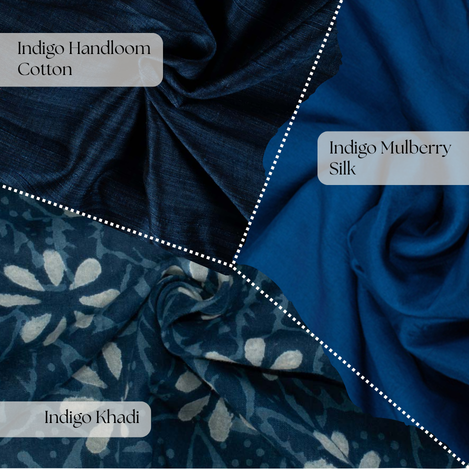
At Anuprerna, indigo is available across three distinct fabric types — khadi cotton, woven cotton, and mulberry silk. Each has a distinct feel, a distinct use-case profile, and a distinct price-to-value proposition. Here is an honest breakdown of all three.
1. Indigo Khadi Cotton Fabric
Texture, Craft, and Slow Fashion Value
Indigo khadi is the most texturally distinctive of the three. Hand-spun and hand-woven by artisan weavers — primarily in Bengal — khadi carries inherent slub irregularities, weight variation between panels, and a matte surface that absorbs and holds indigo with particular richness.
What makes it different from other indigo cottons:
- The hand-spinning process creates slightly uneven yarn — which translates to a fabric with visible character and depth
- Natural vat-dyed indigo on khadi tends to fade unevenly and beautifully with washing — creating the 'wabi-sabi' ageing quality that slow fashion buyers prize
- Azo-free synthetic indigo on khadi gives a more consistent depth and better colorfastness (Grade 4–5), while still retaining the artisan weave character
- Weight range: typically 100–180 GSM, making it suitable for everything from light shirts to heavier outerwear
Best end-uses for indigo khadi:
- Casual and everyday apparel — shirts, trousers, dresses, kurtas
- Collections with a strong artisan-craft narrative
- Brands looking for a denim-substitute aesthetic without using synthetic denim
- Buyers developing Japanese-influenced capsules or utility workwear lines
Honest considerations:
- Batch consistency will always have some natural variation — khadi's handmade nature means no two rolls are perfectly identical. For brands that require tight colour uniformity across a large run, azo-free synthetic dyed khadi is the better option over natural vat
- Not ideal for high-speed machine sewing without some tension adjustment — the slub yarn requires a slightly experienced hand
2. Indigo Cotton Fabric (Woven Handloom)
Consistency for Scalable Production
Indigo handloom cotton sits between khadi and silk in terms of surface finish. It is woven — not hand-spun — which gives it a smoother, more consistent surface than khadi, while still retaining the authentic irregularities of handloom construction.
Key buyer considerations:
- Available in a wider weight range — from 80 GSM lightweight shirting cotton down to 160 GSM structured fabric
- Azo-free dye is standard; colorfastness at Grade 3-4 across washing and rubbing
- More uniform appearance than khadi — better suited to collections requiring colour consistency across large runs
- Easier to sew in commercial production environments
- GOTS-certified versions available — important for brands selling into EU and US markets
Best end-uses for indigo cotton:
- Volume wholesale orders where consistency matters
- Everyday casualwear, shirting, trousers, and outerwear
- Brands building a classic wardrobe with a sustainable supply chain story rather than a craft narrative
- Interior brands exploring indigo cotton for cushion covers, runners, or panel fabric
3. Indigo Mulberry Silk Fabric
Premium Drape and Luxury Appeal
Indigo mulberry silk occupies a completely different market position from the two cotton variants. It is unambiguously premium — a product for luxury sustainable labels, resort collections, and occasion-wear lines where price per metre reflects the story of sericulture, skilled reeling, and careful dyeing.
Why buyers choose indigo mulberry silk:
- The natural lustre of mulberry silk gives indigo an entirely different visual quality — deeper, with a light-catching quality that cotton cannot replicate
- Drape is exceptional — fluid and bias-cut ready, ideal for gowns, refined separates, and luxury resort wear
- Temperature-regulating properties: naturally cool in warm weather, the fibre manages moisture differently from cotton
- Biodegradable and produced with significantly lower pesticide use than conventional cotton
On longevity: well-cared-for mulberry silk garments can last 10–15 years — considerably longer than cotton equivalents — which is a compelling sustainability argument for brands building a 'buy less, buy better' narrative.
Important buyer considerations for indigo silk:
- Price per metre is significantly higher than cotton variants — factor this into your cost-per-garment planning
- Care requirements: hand wash or dry clean; not suited for production environments that need frequent machine washing
- For buyers sourcing ethical silk specifically, Anuprerna's mulberry silk comes from artisan sericulture clusters with verified fair-wage employment — an increasingly important claim for premium ethical labels
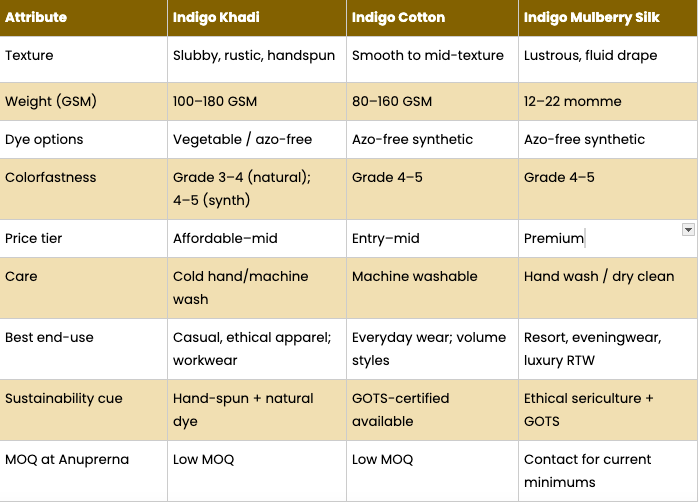
Side-by-Side Comparison: Indigo Khadi vs Cotton vs Mulberry Silk
Understanding Indigo Dye Processes: What Buyers Need to Know
Natural vs Azo-Free Indigo Dye: Key Differences
One of the most common sourcing questions around indigo fabric is about the dye — specifically, whether natural vat-dyed indigo or azo-free synthetic indigo is the right choice for a given brief. Here is a practical guide.
Natural Vat-Dyed Indigo
- Source: Indigofera tinctoria plant, processed into a fermentation vat for dyeing
- Appearance: Deeper, slightly uneven tones — no two batches are identical. Over time, the colour 'lives' and fades in a way that adds character
- Colorfastness: Wash Grade 3–4; rub fastness Grade 3. Lower than synthetic — buyers should communicate this to end customers as a feature, not a defect
- Best for: Brands with a strong natural provenance story; collections where dye variation is an aesthetic asset
- Lead time: Adds 2–3 weeks to standard lead time
- Certifications: Can be accompanied by documentation on dye source and process
Azo-Free Synthetic Indigo
- Appearance: Consistent, reproducible shade across the batch
- Colorfastness: Wash Grade 4–5; rub fastness Grade 4–5 — significantly better than natural
- Best for: Brands requiring colour consistency across a large run, or with strict compliance requirements for azo dyes
- Lead time: Standard production schedule
- Certifications: GOTS-certified versions available
At Anuprerna, both options are available across all three fabric types. The team will advise on the best dye approach based on your end-use, target market, and volume requirements.
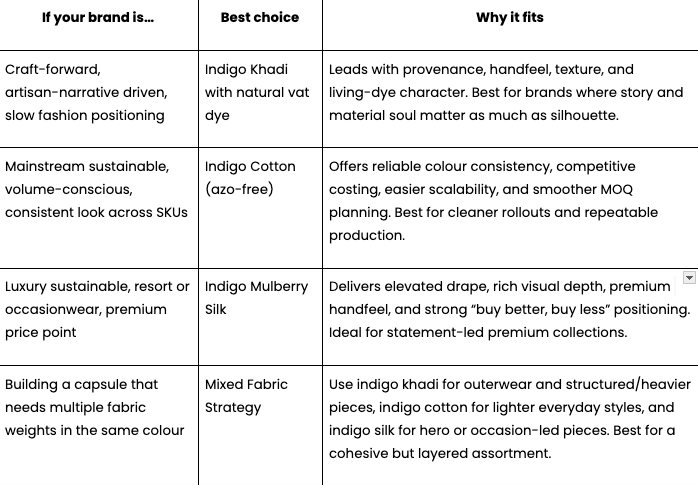
Choosing the Right Indigo Fabric for Your Collection: A Decision Guide
Why Ethical Fashion Brands Source Indigo from Anuprerna
Why Brands Choose Anuprerna for Indigo Fabric Sourcing
Beyond the fabric specs, wholesale buyers increasingly want to know where and how their fabric is made. Anuprerna's indigo offering is built on a transparent production model that gives brands a verifiable supply chain story.
- 500+ Bengal artisan weavers — hand-weaving khadi and handloom cotton in fair-wage, safe conditions verified by third-party impact measurement (60 Decibels, Acumen)
- ArtisanFlow platform — Anuprerna's proprietary supply chain tool gives B2B partners real-time visibility into production stages, so you can track your fabric order from loom to dispatch
- Low MOQ — designed for sustainable brands building capsule collections or testing new fabric directions before scaling
- Azo-free dyes as standard — with natural dye documentation available for brands requiring full chemical-free provenance
- Multi-fibre indigo range — khadi, cotton, and mulberry silk all available in indigo shades, allowing brands to source a coherent indigo palette across garment types from a single supplier
India's KVIC recorded a record turnover of USD 20.5 billion in 2024–25 (IBEF), a signal of sustained institutional and commercial momentum behind artisanal textile production. For brands building long-term supplier relationships, partnering with established artisan networks now positions them ahead of demand.
How to Order Indigo Fabric Wholesale from Anuprerna
Step-by-Step Guide to Ordering Indigo Fabric Wholesale
- Request a SwatchKit: Order physical swatches of indigo khadi, indigo cotton, and indigo mulberry silk. Evaluate drape, colour depth, and handle in your design studio.
- Specify your dye preference: Natural vat or azo-free synthetic. Include any certification requirements for your target markets.
- Confirm GSM and width: Available weights vary by fabric type. The Anuprerna team will advise on what's in stock and what can be woven to your specification.
- Sample yardage: Cut and sew a test garment before committing to bulk. Test wash fastness under your own production conditions.
- Place your wholesale order: Confirm fabric type, dye process, quantity, and delivery schedule with the Anuprerna team.
Start Your Indigo Fabric Sourcing Today
Find the Right Indigo Fabric for Your Next Collection
Whether your next collection calls for the artisan texture of indigo khadi, the versatile consistency of indigo handloom cotton, or the luxury drape of indigo mulberry silk — Anuprerna's SwatchKit lets you feel the difference before you commit.
frequently asked questions
Can I order all three indigo fabrics — khadi, cotton, and silk — in a single wholesale shipment?
Yes. Anuprerna's multi-fibre range allows you to consolidate your indigo sourcing into a single supplier relationship and, in most cases, a single shipment. Minimum quantities apply per fabric type — contact the team for current thresholds.
How consistent is the colour across different fabric types? Will my indigo khadi and indigo silk match?
Due to the different fibre structures and dye uptake characteristics of khadi, cotton, and silk, there will always be some tonal variation between fabric types — this is inherent to how natural and semi-natural fibres respond to dye. If you need all fabrics in a collection to read as one consistent indigo shade, the team can work with you on shade matching, but exact replication across fibres is not possible. This is typically presented as a design feature in ethical fashion collections.
Is natural vat-dyed indigo compliant with EU azo dye regulations?
Natural indigo (Indigofera tinctoria) is not a synthetic azo dye and does not contain the prohibited amines covered by EU REACH regulations. It is one of the few blue dyes with a fully natural origin. For buyers requiring complete documentation, Anuprerna can provide dye source records for natural indigo orders.
What is the typical lead time for indigo fabric wholesale orders?
Standard lead time for azo-free synthetic indigo is 4–6 weeks depending on quantity. Natural vat-dyed indigo typically adds 2–3 weeks to the standard timeline. Exact lead times are confirmed at time of order based on current production scheduling.
Do you offer custom indigo shades — lighter wash or darker navy?
Yes, Anuprerna offers custom shade development for established wholesale partners. Lighter wash indigo, mid-indigo, and deep navy-indigo are all achievable. The process requires swatch approval before bulk production. Contact the team to discuss shade development for your next collection.
More Blogs

khadi jeans for men: styling sustainable denim
eco-friendly trims: sourcing sustainable fashion accessories
how to choose the right fabric wholesaler for your brand
what to look for in a silk manufacturer before you source
how does sustainable sourcing affect clothing quality?

what is a sustainable designer? roles, responsibilities, and impact